
Home > International Partnerships > Collaborative Research > Coexistence mechanism of four bamboo species in tropical seasonal forests focusing on resistance to forest fire
Update:October 9, 2026
Main content starts here.
Coexistence mechanism of four bamboo species in tropical seasonal forests focusing on resistance to forest fire
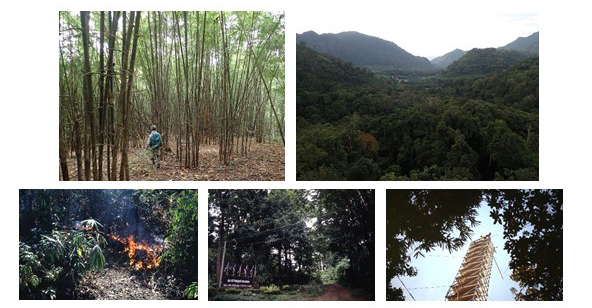
1. Partners
Kasetsart University, Thailand
2. Research Period
FY 2022-2026 Grant-in-Aid for Scientific Research (KAKENHI)
3. Lead Researcher
HIRAI, Keizo(Research Planning Department)
4. Background
Our research group has clarified through long-term observations for about 30 years that the dynamics of tropical seasonal forests are driven by the interaction between "forest fires in the dry season" and "control of tree regeneration by bamboos". Biodiversity of bamboos is generally high in tropical seasonal forests, but there has been no hypothesis about its coexistence mechanism in the past. Bamboo has a trade-off between resistance to forest fires and regeneration and growth after gregarious flowering. In this study, we test the hypothesis that bamboos coexist in different forest fire regimes depending on the topography.
5. Research Goal
The purpose of this study is to elucidate the coexistence mechanism of four species of bamboo and its determinants in the slope of forest fire frequency according to the topography in the tropical seasonal forest of Thailand. To this end, we will clarify two points: 1) the trade-off relationship between the growth in the early regeneration stage of bamboos and the forest fire resistance trait, and 2) the interspecific differences and characteristic traits related to it, and their acquisition mechanism of forest fire resistance.
6. Research Strategy
First, we will clarify the interspecific difference in propagation timing and the regeneration mechanism for each of the four bamboo species. Next, we will elucidate the traits related to the fire resistance function of bamboo and clarify the acquisition process of those traits. In addition, we will clarify the distribution of soil moisture and inorganic components along the topography of the experimental plot as soil environmental factors that can control these. Finally, based on these factors, we will elucidate why four types of bamboo can be distributed and coexist in tropical seasonal forests under frequent forest fires.
7. Publications
Dokrak Marod, Tohru Nakashizuka, Tomoyuki Saitoh, Keizo Hirai, Sathid Thinkampheang, Lamthai Asanok, Wongsatorn Phumphuang, Noppakun Danrad and Sura Pattanakiat(2023)Long Term Seasonal Variability on Litterfall in Tropical Dry Forests, Western Thailand. Forests 2023, 14(10), 2107; https://doi.org/10.3390/f14102107
Dokrak Marod, Warong Suksavate, Sathid Thinkampheang, Wongsatorn Phumphuang, Lamthai Asanok, Torlarp Kamyo, Sutheera Hermhuk, Panida Kachina, Tomoaki Ichie, Tomoyuki Saitoh, Tohru Nakashizuka, Weerapat Plyme(2025)Relationships between soil seed banks and adult tree distance in an abandoned area of the Mae Klong Watershed Research Station, western Thailand. Journal of Plant Ecology.19(1), https://doi.org/10.1093/jpe/rtaf130( External link ) 
Tomoyuki Saitoh, Dokrak Marod, Hiroshi Tanaka, Keizo Hirai, Sathid Thinkamphaeng and Tohru Nakashizuka(2026)Population dynamics of four co-occurring tropical bamboo species induced by gregarious flowering in a tropical seasonal forest, Thailand. Journal of Forest research, 1–11. https://doi.org/10.1080/13416979.2026.2690349( External link )
Dokrak Marod, Tohru Nakashizuka, Tanaka Hiroshi, Tomoyuki Saitoh, Wongsatorn Phumphuang, Sathid Thinkampheang, Warong Suksavate, Sutheera Hermhuk, Lamthai Asanok (2026)Local topographic and biotic neighborhood factors influence tree survival in a tropical dry forest, western Thailand. Ecological Processes, 15(5), https://doi.org/10.1186/s13717-025-00665-2( External link )
Copyright © Forest Research and Management Organization. All rights reserved.